

Picture settling into your office chair on a Monday morning, your cup of coffee steaming beside your computer. You start your week by scrolling through the latest customer reviews. There’s a mix of glowing praise and a couple of critiques. With your day’s tasks already piling up, you wonder — is it worth taking the time to respond?
It’s a scenario that any business professional can relate to. That nagging question of whether or not to engage with online reviews might seem trivial. But what if it impacts more than just your relationship with customers? What if it’s tied to the heartbeat of your online visibility—your search engine ranking?
Let’s delve into whether responding to reviews really does help SEO, and how this seemingly small task could have big implications for your business.
Table of contents
What does Google say about responding to reviews?
To understand the impact of responding to reviews on SEO, who better to turn to than Google itself? While the tech giant doesn’t hand out step-by-step instructions on how to rise in the rankings, they do sprinkle clues throughout their support documentation and resources.

The screenshot below is taken directly from Grow with Google, created by the search engine with the goal of helping people improve their digital skills. They advise:
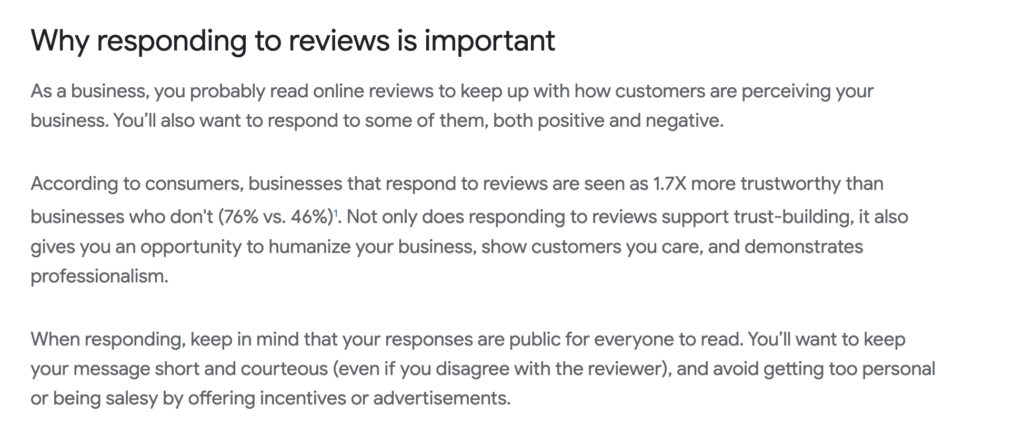
“According to consumers, businesses that respond to reviews are seen as 1.7X more trustworthy than businesses who don’t (76% vs. 46%). Not only does responding to reviews support trust-building, it also gives you an opportunity to humanize your business, show customers you care, and demonstrates professionalism.”
What’s clear from this statement is Google’s emphasis on valuing customer interaction. While they might not say it directly, the underlying message resonates with their broader philosophy: creating meaningful connections with users and providing relevant content.
It’s worth pausing to consider what this means in the grander scheme of SEO. Google’s algorithms are notoriously complex, but user experience is at the heart of their design.
By valuing your customers and their feedback by engaging with reviews, you align with the principles that guide Google’s algorithm. The more you do so, the more you build your online visibility, enjoy better search rankings and establish a more authoritative presence in your industry.
4 ways responding to reviews boosts your SEO
Now we know what Google says about replying to reviews, but why exactly is it so important? Let’s take a look at some specific ways engaging with your reviews helps boost your search rankings.
1. Help Google better understand your business
Google pays attention to the keywords within your responses to reviews. By “reading” these reviews and your responses, it gets a clearer picture of the products and services your business offers and optimises its relevance to user searches.
For example, say you’re a car dealership and you have lots of five-star reviews raving about the smooth drive and advanced features of a particular model. Let’s call it the Vortex Sedan. You can use responses to these reviews to amplify your rankings for searches related to this model in your area.
A fitting response to a review like this might be:
“Hi [Customer Name], thank you for choosing [Dealership Name] for your recent purchase. We’re ecstatic to hear you’re loving the comfort and cutting-edge features of the Vortex Sedan. It’s customers like you who make our job in [City] so rewarding. Safe travels on the road, and remember, our team is always here should you need anything in the future!”
By incorporating specific model names and your dealership’s location in your responses, you better position your listing for potential customers seeking similar vehicles or experiences.
2. Increase engagement with your listing
When you respond to reviews, it encourages people to spend longer on your listing reading through your replies. It means they’re more likely to be curious about your offering, leading them to click on your website or contact details for more information.
More time spent on your listing and higher click-through rates send a strong signal to Google. It tells them that users find your listing valuable and relevant to their search. If there’s one thing we know about Google, is that the search engine giant is all about relevance. So, the more you engage, the better your chances of climbing those search rankings over time.
3. Build connections with your customers
Writing a personalised response to a review does a few things. It:
- Sends a message that you value your customers’ opinions
- Shows that there’s a human behind the brand
- Bridges the gap between your business and the customer
All this works together to build trust in your business, leading to increased engagement with your website as visitors feel more connected and understood.
Now, let’s talk about SEO. Trust isn’t just a warm, fuzzy feeling; it has tangible implications for your site’s performance. A trusting visitor is more likely to explore multiple pages, spend more time on your site, and less likely to “bounce” back to the search results.
These factors–bounce rate and time on page–are recognised SEO signals. They tell search engines that your site is providing value, and in turn, this can improve your ranking.
4. Encourage more reviews
If you knew that a business owner would respond to your feedback, would you be more likely to leave a review yourself?
People are inherently influenced by their peers. When customers see their feedback being valued and acknowledged, it motivates others to share their own experiences. This has a knock-on effect on your SEO.
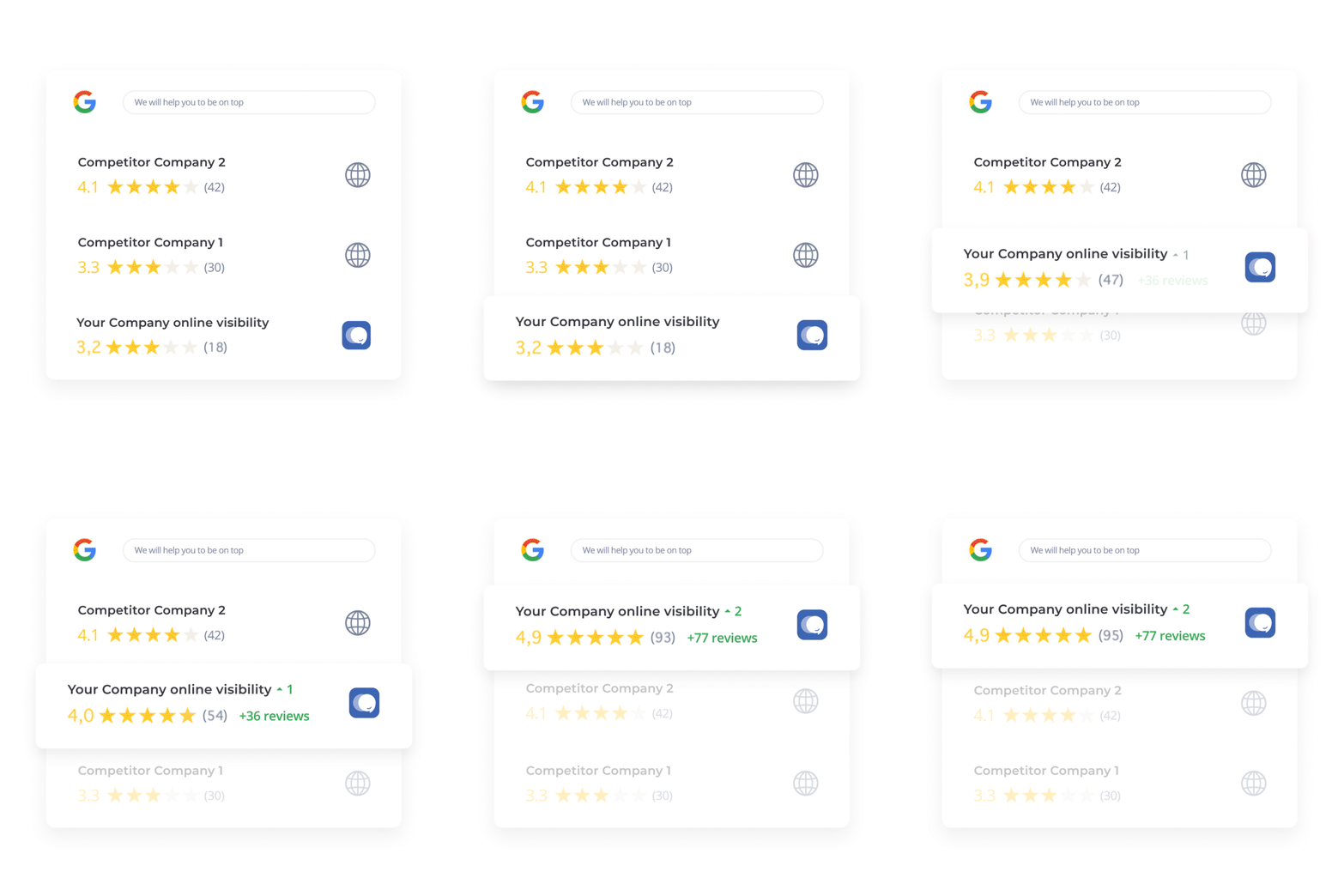
User-generated content, like reviews, adds freshness and relevance to your site. Search engines love content that is updated regularly and resonates with the audience.
By encouraging more reviews through your active response, you indirectly fuel your SEO engine, making your online presence more attractive to users and search algorithms alike.
Embrace the power of engagement for your online presence
When it comes to improving your search engine rankings, don’t underestimate the impact of responding to reviews.
Every response is a nudge to Google, signalling that your business is not just another name in the list. It’s active, it’s relevant, and it’s connected with its audience. Beyond the metrics and the algorithms, it’s this human touch that can set you apart.
So, next time you come across a review, positive or negative, think of it as an invitation to build your business’s online presence. In the world of SEO, it’s these seemingly small gestures can lead to monumental shifts in visibility.
FAQs about responding to reviews and SEO
How often should I respond to reviews for the best SEO results?
Consistency is key. Aim to respond to all reviews, both positive and negative, promptly. Regular interactions signal that your business is active and values customer feedback. While there isn’t a strict frequency that guarantees SEO improvements, the general rule is the sooner and more consistently you respond, the better it is for building trust and online presence.
Pro tip 💡: Don’t have the time or resources to reply to all your reviews efficiently? Our AI Reply Assistant generates unique, personalised review replies in just one click.
Does the content of my response to reviews influence SEO?
Yes, the content of your response does matter. By incorporating relevant keywords naturally into your replies, you can subtly reinforce the products or services you offer, and this can aid in improving local SEO. However, always prioritise genuine engagement and clarity over keyword stuffing.
Can responding to negative reviews also benefit my SEO?
Absolutely. Responding to negative reviews constructively and professionally showcases your commitment to customer service. It not only helps in damage control but can also turn a negative experience into a positive one.
From an SEO standpoint, search engines don’t differentiate between positive or negative reviews; it’s the engagement and relevant content that matters. Addressing issues and providing solutions can also lead to enhanced user trust and brand credibility.


