


Picture the scene: Saturday night. You slump onto the couch, remote control in hand… but then the ordeal begins.
Canal+? Netflix? Prime Video? After a 2-minute debate, you land on Netflix.
There, it’s chaos:
— “A series?”
— “A movie!”
— “An action thing?”
— “A classic that we know?”
And sometimes… we don’t look at anything at all.
Have you ever experienced this? With family, with friends?
Welcome to the world of “Choice Overload”, or choice overload.
What is Choice Overload?
This phenomenon, popularized by Barry Schwartz, is defined by Decision Lab as follows:
“Choice overload, also known as choice excess, choice paralysis, or choice paradox, describes how people feel overwhelmed when faced with too many options.”
To conclude: The more choices you have, the harder it is to choose — and the more you doubt your decision.
Have you ever walked into a salad bar with 50 different toppings? Signs everywhere, unknown sauces… chaos.
Conversely, if we tell you: base + 3 ingredients of your choice, everything becomes clear. Clarity = relief.
Psychologically, it is even deeper:
- We always imagine that a “best option” exists.
- We ruminate even after we have decided.
- And our mental bandwidth is limited.
This is why we distinguish two profiles:
- The Maximizers, who are looking for the perfect option — but are more doubtful.
- The Satisficers, who aim for a sufficient option — and are often more satisfied.
The key? Finding a balance. As illustrated in this paradox of choice curve:
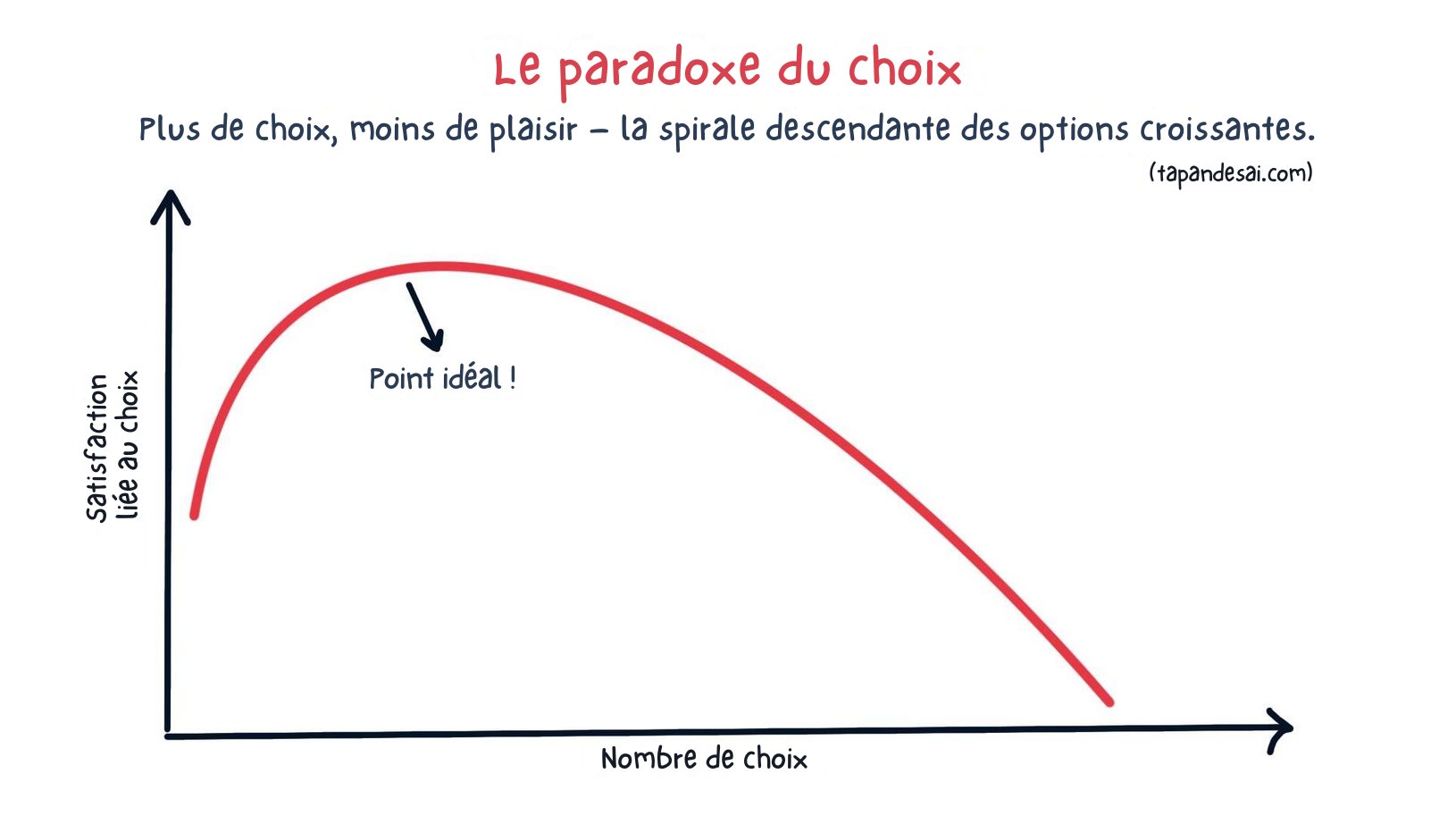
source: tapandesai.com
And you, hospitality professionals?
Restaurateurs, hoteliers… you’re on the front line. “Too much choice” isn’t just an abstract concept: your customers experience it every day, often without realizing it.
Two recent studies provide a better understanding of this phenomenon and its concrete impacts.
Solutions for you
On the catering side: a reduced menu, an amplified experience
Ask yourself the question: Is your menu an invitation… or a labyrinth?
A Harvard study demonstrated this: Reducing the number of options improves customer perception.
Too much of a menu confuses attention, slows decision making, and can lead to frustration.
Conversely, A short menu inspires confidence, reinforces the image of quality and facilitates purchasing.
It is no coincidence that gourmet restaurants favor refined menus:
Fewer dishes, more perceived value. Every choice becomes a promise better defended — and a margin easier to justify.
💡 A question of cognitive load : according to Guillet, Mattila & Gao (2019), offer between 3 and 9 options allows for smooth processing.
Beyond 30, the brain saturates. And the more it saturates, the less we order.
On the hotel side: simplify the offer without impoverishing it
The sector is booming ($512,5 billion in 2023, forecast $1 billion in 260), but the booking experience remains shaky :
Only 26% of travelers find it really pleasant.
Why? Because a multitude of options, poorly presented, damages trust and hinders conversion.
Industry leaders (OTAs) have understood this trap and are relying on powerful psychological levers :
- Scarcity : “Only 2 rooms left!”
- Social proof : “10 people are looking at this room”
- Anchoring : offer a room at €300 before the one at €220 to make it more attractive
- Architecture of choice : a structured path → filters → sorting → guided comparison
👉 Take inspiration from these methods while maintaining a human and personalized approach:
- Smooth navigation with relevant recommendations
- Pre-packaged offers : stay for couples, families, spa weekends…
- Visual filters : price, view, bathtub, type of bed…
The recap: no time to read everything? Here’s the essentials
Too many choices make it difficult to make a decision.
Whether in front of Netflix or in a restaurant, The abundance of options causes stress, frustration… even inaction.
- Choice Overload = mental overload → less satisfactory decisions.
- The more choices there are, the more doubt there is… even after choosing.
Restaurateurs
- Short menus = easier decisions, better perception of quality, increased margins.
- Long menus = confusion, hesitation, dissatisfaction.
Hoteliers
- Booking is still too complex (only 26% find it pleasant).
- To implement:
- Smooth navigation
- Simple and clear offers
- Effective visual filters
📬 To receive more concrete advice on customer experience, Subscribe to our newsletter.


